







Badge production is a budget line with a hidden multiplier. Get it wrong and you absorb 40–60% waste on no-shows, freeze your walk-in desk, and create compliance exposure across every data protection regime in Asia — all before your event has opened its doors. Getting onsite registration system right starts here: with the decision of how your badges are made.
For a trade exhibition between 500 and 15,000 attendees, that decision looks deceptively simple. It is not. Pre-printing and on-demand printing have fundamentally different total cost structures, operational risk profiles, sustainability footprints, and compliance implications. Most Asian exhibition organisers choose based on unit cost per badge. That is the wrong variable to optimise.
What Is Actually the Difference Between Pre-Printed and On-Demand Badge Production?
Pre-printing produces all badges before the event, at a print shop, weeks in advance. On-demand printing produces each badge at the moment an attendee checks in, triggered by a QR code scan or facial recognition. Pre-printing optimises for unit cost. On-demand optimises for total system cost — including waste, walk-in failure rate, compliance risk, and queue time. For most trade exhibitions in Asia above 500 attendees, on-demand wins the total cost comparison.
4 Dimensions Where the Two Models Diverge
- 1Waste economicsPre-print generates badges for every no-show plus a 10–15% planning buffer. At a typical Asian trade exhibition with 20–40% no-show rates, 25–45% of all printed badges go straight to the bin. On-demand produces only for attendees who physically check in.
- 2Walk-in handlingPre-print systems have no natural mechanism for walk-ins. Staff fall back to handwritten stickers or generic badges — creating security gaps, incomplete data, and a degraded first impression. On-demand handles walk-ins identically to pre-registered attendees.
- 3Data compliance exposurePre-printed boxes contain visible personal data — names, companies, encoded QR contacts — sitting in warehouses and transit from the moment of printing until the event. On-demand eliminates this exposure window entirely.
- 4Operational flexibilityPre-printing requires a hard registration cutoff two or more weeks before the event. On-demand accepts registrations up to the moment of check-in, with zero reprint cost for name or title changes.
A 3,000-registrant trade exhibition in Kuala Lumpur. Organisers pre-print 3,450 badges (15% buffer). On the day, 960 registered attendees are no-shows — a 32% rate. Of the 3,450 printed badges, 1,410 are never used. That is 41% waste. The walk-in desk handles 178 unregistered visitors with blank stickers. None of their details enter the attendance database. Two sponsors notice their leads are missing from the post-event analytics export.
How Much Does Badge Production Actually Cost — Pre-Print vs. On-Demand?
Pre-print looks cheaper at the unit level — USD 0.50 to 1.50 per badge at volume in Asia, versus USD 1.50 to 3.50 per on-demand badge including equipment. But once you account for no-show waste, buffer over-ordering, sorting labour, logistics, and walk-in failure costs, on-demand becomes cost-competitive at 2,000 attendees and cheaper above 5,000.
True Total Cost: The 5 Components Organisers Forget to Add
- 1No-show wasteAt a 25% no-show rate on a 5,000-registrant event with 15% buffer, approximately 1,875 badges are printed and never used. At USD 1.50 per badge, that is USD 2,813 in pure waste.
- 2Sorting and distribution labourPre-printed badges must be alphabetically sorted, then located at check-in at 5–8 seconds per attendee. For 5,000 attendees, that is 7–11 hours of pure sorting time before a single attendee arrives.
- 3Shipping and storage logisticsBadges must be printed at a facility, packaged, shipped to the venue, and stored securely. Cross-border shipping for major regional shows adds USD 200–500 per event.
- 4Reprint cost for last-minute data changesEvery name correction, title update, or late addition after the print deadline either requires an expensive emergency reprint or results in a wrong-name badge being issued.
- 5Walk-in failure costWalk-ins who cannot be properly badged are invisible in your data. Sponsors whose leads are missing from the post-event export are sponsors who do not renew.
"I ran a show where the organiser had budgeted for pre-printed badges and considered the matter closed. On the day, we had 160-plus walk-ins by 10:30 AM. The desk team were writing names on blank stickers with Sharpies and handing them out with no record at all. After the event the organiser asked me why the attendance figure in the data export was lower than the headcount on the floor. Two of those invisible people were buyers from accounts the sales team had been targeting for a year. No one knew they had been there."
"Total Cost of Ownership by Event Scale
| Event Scale | Pre-Print Total Cost | On-Demand Total Cost | Pre-Print / Useful Badge | On-Demand / Useful Badge |
|---|---|---|---|---|
| 500 attendees | USD 2,000–2,500 | USD 5,000–6,500 | USD 4.00–5.00 | USD 10.00–13.00 |
| 2,000 attendees | USD 5,000–7,000 | USD 8,000–12,000 | USD 2.50–3.50 | USD 4.00–6.00 |
| 5,000 attendees | USD 11,000–14,000 | USD 10,000–15,000 | USD 2.20–2.80 | USD 2.00–3.00 |
| 10,000+ attendees | USD 20,000–30,000 | USD 15,000–25,000 | USD 2.00–3.00 | USD 1.50–2.50 |
How Does On-Demand Badge Printing Actually Work at a Trade Exhibition?
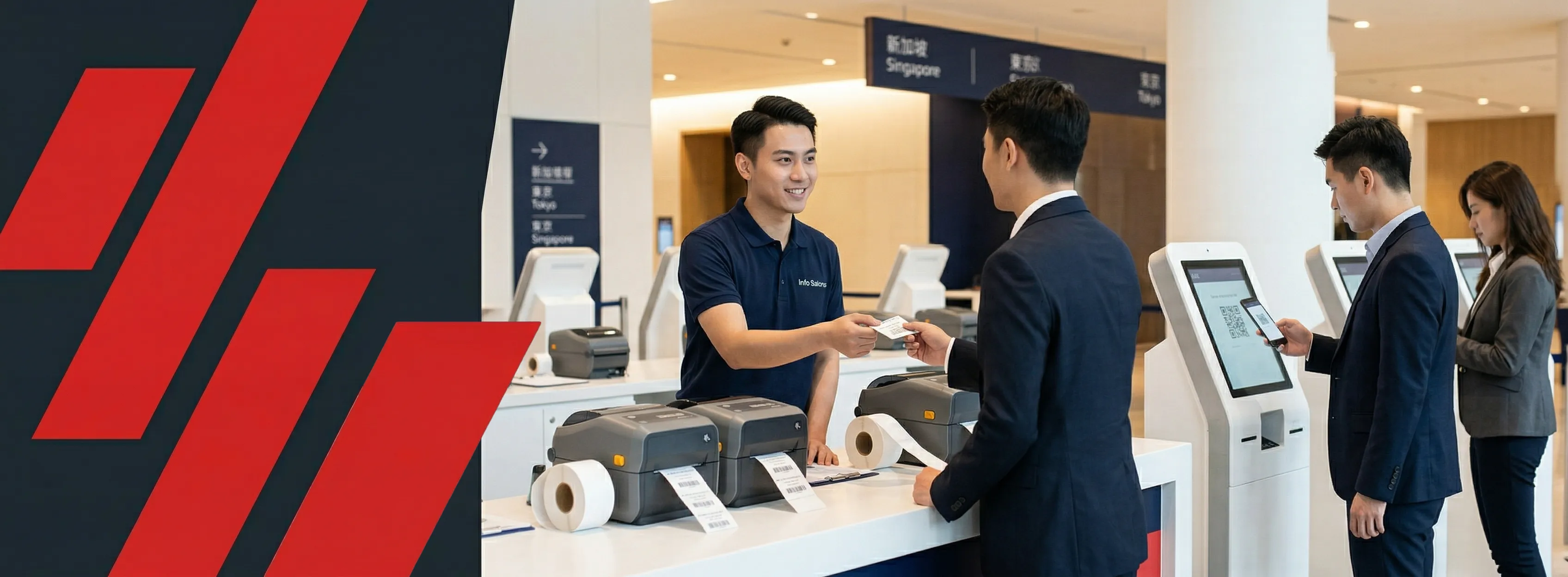
An attendee scans a QR code from their email or mobile app at a kiosk or staffed counter. The scanner verifies their registration record, sends badge data to a connected thermal or inkjet printer, and produces a personalised badge in 6–10 seconds. The entire check-in event — scan, verify, print, exit — takes under 15 seconds per attendee when the system is correctly configured.
The On-Demand Workflow in 5 Steps
- 1Pre-event: QR code deliveryThe registration platform sends each attendee a unique QR code via email, WhatsApp, or WeChat Mini Program.
- 2At the kiosk: scan and verifyAttendee presents QR code to the kiosk scanner. The system matches against the local cached database in under one second.
- 3Print trigger: badge data sent to printerThe system transmits badge data to the connected thermal printer via USB, Ethernet, or WiFi. Print time: 6–10 seconds for standard badges.
- 4Badge collection and lanyard stationThe freshly printed badge ejects from the printer slot. The check-in timestamp is simultaneously logged to the central database.
- 5Walk-in: same workflow, no queue penaltyUnregistered walk-ins register on a tablet at a dedicated counter. Their record is created in real time, a QR code is generated, and their badge prints immediately.
A 6,000-attendee manufacturing trade show at IMPACT Arena, Bangkok. 14 self-service kiosks equipped with Zebra ZD421 printers and a locally cached database synced 48 hours before the event. Peak arrival: 2,800 attendees between 9:30 and 10:30 AM. 312 walk-in visitors are registered and badged at 2 dedicated walk-in counters using the identical workflow. All 312 enter the post-event attendance database. Sponsors receive complete data including walk-in buyer profiles.
Should You Use a Hybrid Model — Pre-Print VIP, On-Demand for Everyone Else?
Yes — for most large-scale Asian trade exhibitions, a hybrid model is the optimal default. Pre-print premium badges for VIPs, speakers, and contracted sponsors whose attendance is near-certain and whose badge requires premium materials. Print on-demand for all other attendees.
When to Pre-Print vs. When to Print On-Demand
- 1Pre-print when: attendance is above 95% certainContracted platinum sponsors, keynote speakers, organising committee members, and government officials with confirmed attendance.
- 2Pre-print when: the badge requires premium materialsPVC card with embedded RFID for spatial tracking, holographic overlays for security events, multi-day laminates for exhibitor passes.
- 3Print on-demand when: registration remains open close to the event dateAny category where registrations are still arriving in the final 72 hours before the event.
- 4Print on-demand when: walk-in volume is unpredictableB2B trade shows, consumer exhibitions, and public-access events routinely see 10–20% of total attendance arrive as walk-ins.
- 5Always: maintain on-demand as your backup systemEven if you pre-print VIP badges, your on-demand system must be ready to produce a replacement instantly if a VIP badge is lost or damaged.
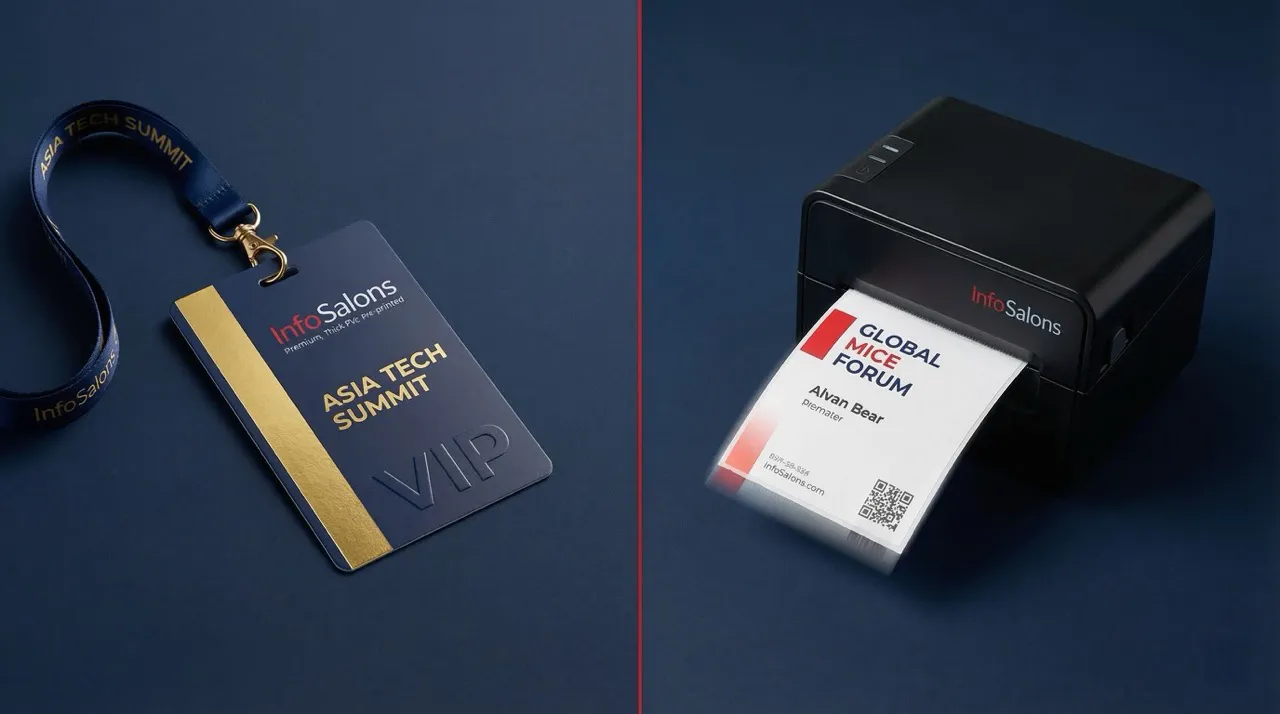
"We set up a dedicated VIP lane for a show in Hong Kong — proper signage, two staff, pre-printed badges in sleeves, the full setup. By 9:20 AM I counted six VIPs standing in the general queue. They walked straight past the VIP desk because they were looking at their phones. Now I keep a hot-spare on-demand printer at every VIP station regardless of whether the brief calls for pre-print. When a VIP walks up to the wrong desk, you print him a badge in eight seconds and he never knows the difference."
"Regional healthcare trade show, 4,200 attendees, Shanghai NECC. Hybrid approach: 85 confirmed VIPs and speakers receive pre-printed PVC badges with embedded RFID. All other 4,115+ attendees processed via on-demand thermal printing at 22 self-service kiosks. Net result: the organiser absorbs VIP no-show waste on 6 badges (7% of VIP pool) rather than 1,470 badges (35% of the full pre-printed run). Badge material cost reduction: approximately 38%.
Does Badge Production Method Affect Sustainability Performance at Your Exhibition?
Yes — significantly. On-demand printing eliminates no-show waste entirely, reduces total badge material by 20–45% at events with meaningful no-show rates, and is directly compatible with sustainable badge substrates like FSC-certified recycled paper, seed paper, and bamboo fibre.
4 Sustainability Actions — Ranked by Impact for Asian Trade Exhibitions
- 1Switch to on-demand printing — the highest-impact single actionAt a free-to-attend trade exhibition with a 40% no-show rate, pre-printing wastes 40% of all badge material before the event begins. On-demand eliminates this entirely.
- 2Use sustainable badge substratesFSC-certified recycled paper, seed paper, bamboo fibre, and recycled PET. Standard plastic badge holders take up to 500 years to decompose.
- 3Deploy lanyard collection stations at exitsRecovery programmes at exit points achieve up to 98% collection rates for reusable badge shells and lanyards.
- 4Eliminate badge shipping carbonPre-printing requires logistics from print shop to venue. On-demand printing at the venue eliminates this supply chain entirely.
What Are the Data Compliance Risks of Pre-Printed Badges in Asia?
Pre-printed badges create a prolonged personal data exposure window. Under Singapore's PDPA, Thailand's PDPA, and China's PIPL, this constitutes a data security vulnerability with direct enforcement implications. On-demand printing minimises this window to the moment of check-in.
5 Compliance Risks Specific to Pre-Printed Badge Systems
- 1Unsecured physical storage of personal dataA box of 5,000 pre-printed badges is a physical database. If it is lost in transit or accessed without authorisation, every attendee's personal data is exposed. Under PDPA and PIPL, this is a reportable breach.
- 2No ability to remotely deactivate compromised dataIf a pre-printed badge box is lost, the QR codes on every badge can be scanned by anyone with a smartphone to extract vCard data. There is no kill switch.
- 3Data retention violation on cancelled registrationsIf an attendee cancels after the print deadline, their badge exists in physical form with their personal data — contradicting data minimisation principles under all three jurisdictions.
- 4Third-party print shop data accessPre-printing requires uploading your complete attendee database to an external print vendor. Under PDPA and PIPL, this is a data processor relationship requiring a Data Processing Agreement.
- 5Cross-border data transfer for international print fulfilmentIf your print vendor is in a different jurisdiction from your event, you may be triggering cross-border transfer obligations under PIPL or GDPR.
Compliance Comparison by Badge Production Method
| Compliance Factor | Pre-Print | On-Demand |
|---|---|---|
| Personal data exposure window | Weeks (print to event) | Seconds (check-in only) |
| Physical data breach risk | High (lost/accessed box) | None (no pre-print stock) |
| Right to erasure compliance | Difficult (badge exists) | Clean (no badge produced) |
| Data processor agreement required | ⚠️ Print vendor | ✅ Platform vendor only |
| Cross-border transfer risk | ⚠️ If print vendor offshore | ✅ Contained at venue |
| PIPL data minimisation | ❌ Excess stock holds PII | ✅ No excess stock |
How Do You Handle Walk-In Registration Without a Pre-Print System?
A properly configured on-demand system processes a walk-in visitor — data capture, badge print, check-in record — in under 90 seconds from first contact, with the result fully entered in the attendance database.
Walk-In Handling in 4 Steps with On-Demand
- 1Registration capture at a dedicated walk-in counterStaff open a new registrant record on a tablet connected to the registration platform. Minimum required fields: name, company, email, attendee category. Time: 45–60 seconds.
- 2Immediate QR code generationThe platform generates a QR code for the new record in real time. The counter's scanner reads it immediately — no email delivery required.
- 3Badge print — identical to pre-registered flowThe QR code triggers the printer. The walk-in badge is identical in format to a pre-registered badge. Time: 6–10 seconds.
- 4Record enters the database in real timeThe walk-in attendee is now fully present in the attendance record. Their profile is available in the sponsor lead export.
Which On-Demand Badge Printers Are Best for Trade Exhibitions in Asia?
The Zebra ZD421 is the workhorse standard for most Asian trade exhibitions. For full-colour badge printing, the Epson ColorWorks CW-C4000 delivers photo-quality output in 3–10 seconds per badge. For the highest-throughput environments above 10,000 attendees, the BOCA Lemur produces 12–15 badges per minute.
Hardware Comparison: The 4 Primary Options in the Asian Market
- 1Zebra ZD421 — The standard deployment choiceDirect thermal, 6 inches/second, 6–10 badges per minute. USB, Ethernet, WiFi, Bluetooth. Compatible with most major platforms. Locally serviceable across Singapore, Hong Kong, KL, Bangkok, Shanghai.
- 2BOCA Lemur (FGL46) — High-volume events above 5,000 paxDirect thermal, 10 inches/second, 12–15 badges per minute. Looping badge presenter retracts media if not collected — critical for self-service deployments.
- 3Epson ColorWorks CW-C4000 — Full-colour brand-forward eventsInkjet, up to 1200×1200 dpi, 3–30 seconds per badge depending on design complexity.
- 4Brother QL-820NWB — Smaller events and label-based formatsWiFi-enabled label printer. Well-suited to sub-1,000-attendee events.
The reason badge production keeps generating problems — waste, walk-in failures, missing data, reprint emergencies — is not that organisers are choosing the wrong printer. It is that badge production is being treated as a procurement decision made independently of the registration platform.
That is the architectural problem Info Salons Asia's event data management platform is built to close — a single connected system where online registration, onsite badge printing, access control, and post-event data reporting operate from one source of truth.
Conclusion: Badge Production Is a Registration Architecture Decision
The organisers who get badge production right at scale are not the ones who found the cheapest print shop. They are the ones who stopped treating badge production as a procurement decision and started treating it as the physical output of their registration system architecture.
- 1Default to on-demand above 500 attendeesThe total cost crossover versus pre-print happens at 2,000 attendees. Above 5,000, on-demand is consistently cheaper when waste and labour are costed correctly.
- 2Use the hybrid model — not full pre-printPre-print only for attendees with confirmed attendance above 95% certainty and special material requirements.
- 3Size your walk-in counter as a first-class channelPlan for 5–15% walk-in volume, staff it with a connected tablet and printer, and capture every walk-in visitor in your database.
- 4Address the data compliance exposure windowPre-printed badge boxes are physical databases. For Singapore, Thailand, China, and any event with EU attendees, the compliance risk is a direct enforcement liability.
- 5Make sustainability a selection criterion, not an afterthoughtOn-demand printing with sustainable substrates satisfies Singapore's MSC, GSTC MICE Criteria, and ISO 20121:2024 waste reduction requirements in a single decision.
Frequently Asked Questions
Direct answers — no preamble.
On-demand becomes cost-competitive at approximately 2,000 attendees and cheaper above 5,000 — when total cost is calculated correctly to include no-show waste, sorting labour, logistics, and walk-in failure cost.
Plan for 15–25% no-show rates for paid events and 30–45% for free-to-attend trade exhibitions in Asia.
Not automatically — but it requires a Data Processing Agreement with the print vendor that specifies security standards, data deletion upon job completion, and no onward sharing. Most print shops are not structured as compliant data processors.
Formula: (50% of attendance) ÷ 100 × 1.25 = minimum active printers. For 3,000 attendees: 1,500 ÷ 100 × 1.25 = 19 active printers minimum.
Yes — with an inkjet printer like the Epson ColorWorks CW-C4000, on-demand badges print at up to 1200×1200 dpi with full-colour sponsor logos. Print time is 3–10 seconds per badge depending on design complexity.