







Single-entry access control with no zone differentiation is one of the most expensive planning errors an exhibition organiser can make. When VIPs, exhibitors, press, and general attendees share the same entry lane and the same badge format, problems compound in four directions simultaneously: security enforcement becomes impossible, sponsor zone data disappears entirely, post-event reporting loses its commercial value, and the floor experience degrades for every attendee category that paid for something different. Getting your event access control architecture right before Day 1 means treating zone-based access as a design decision — not a security add-on.
This article covers why zone-blind setups fail structurally, which access control technologies deliver the data sponsors actually require, how to design physical entry lanes for multi-zone events at 1,000–20,000 attendees across APAC, and what data privacy compliance looks like across Hong Kong, Singapore, and mainland China.
Zone-based access control assumes that your onsite registration system has already assigned each attendee a badge type or category. If you haven't reviewed your registration infrastructure yet, start with our guide to onsite registration for large-scale exhibitions in Asia.
Why Zone-Blind Access Control Is a Revenue Problem, Not Just a Security Problem
Zone-blind access control destroys the sponsor data layer that makes exhibition packages commercially renewable. Sponsors who paid for a dedicated zone get no verified footfall data, no dwell time analysis, and no demographic breakdown. A sponsor who cannot verify footfall in their paid zone will not renew.
- 1Unverified zone entryWithout badge-encoded zone permissions, anyone with a valid event badge can enter any area. VIP lounges and sponsor-designated spaces become unenforceable boundaries.
- 2Missing sponsor footfall dataIf a gate scan does not record which zone a badge entered, the sponsor zone visit count is zero.
- 3Badge category confusion on the floorWhen exhibitors, visitors, press, and VIPs carry visually identical badges, access exceptions multiply.
- 4Post-event data reconciliation delayEvents without real-time zone tracking reconstruct access data manually after close — typically 3–5 weeks. Sponsors expect zone reports within 7 days.
- 5No live override capabilityWithout zone-linked access control, revoking a badge requires physically retrieving it. Zone-integrated systems revoke access at the gate in real time.
Event: 9,000-attendee trade fair in Hong Kong. Zone-blind setup: sponsor footfall data = zero verifiable records, no renewals confirmed. Zone-differentiated access control with badge-encoded permissions: end-of-show sponsor zone report includes unique visitors, average dwell time, and demographic breakdown. Both major sponsors renewed within three weeks of close.
Which Access Control Technology Delivers the Sponsor Data You Actually Need
UHF RFID is the only access control technology that simultaneously delivers gate throughput above 500 attendees per hour AND generates passive zone-tracking data without requiring attendees to take any action. Technology choice is a sponsor data architecture decision, not just a hardware decision.
For a full breakdown of how access control integrates into the complete onsite registration operation, see onsite registration for large-scale exhibitions.
| Technology | Throughput / lane / hr | Passive zone tracking | Per-lane cost (USD) | Best fit |
|---|---|---|---|---|
| UHF RFID (portal gate) | 500–1,000+ | ✔ Yes — no attendee action | 1,500–5,000 | 5,000+ pax, sponsor zone data required |
| NFC / HF RFID (tap) | 200–400 | ⚠ Zone tap required | 200–1,500 | Lead retrieval + access hybrid |
| QR code (scan) | 120–180 | ✗ No passive tracking | 100–500 | Budget events, no zone data requirement |
| Facial recognition | 200–400 per kiosk | ✗ Camera grid required | 3,000–10,000+ | VIP fast-lane only; compliance-constrained in CN |
| Manual name lookup | 30–60 | ✗ None | ~0 | Under 200 attendees only |
How Badge Encoding Determines Zone Data Quality
- 1Thin badge / fat server — most common, highest riskBadge stores only a unique ID. All zone permissions validated server-side. Any network interruption means gate validation fails.
- 2Hybrid encoding — recommended for most APAC exhibitionsBadge stores a compact zone-permission bitmask plus a cryptographic signature for offline validation. Correct architecture for 2,000–20,000 attendees.
- 3Rich badge (MIFARE DESFire AES-128) — highest security, highest costAll zone permissions and AES-128 encrypted keys stored on the badge with up to 8KB of memory. Fully offline gate validation.
Event: 12,000-attendee manufacturing trade fair in Singapore with five zones. UHF RFID portal gates, hybrid badge encoding. At close of Day 1: 34,710 zone-entry events logged across 9,847 unique badges. Sponsor zone reports with per-zone unique visitor counts delivered automatically. No manual reconciliation. Reports delivered to sponsors at 7:30 PM Day 1.
Designing the Physical Entry Architecture for Multi-Zone Events in Asia
Multi-zone access control requires physical lane separation designed at the floor plan stage — not adapted from a single-entry layout after the registration zone is installed.
For detailed guidance on entry lane sizing and walk-in integration alongside zone-access lanes, see walk-in registration at trade shows.
- 1Primary entry — validate credential, not zoneFirst gate confirms the badge is a legitimate event credential. Designed for peak arrival volume, not daily average.
- 2Category separation point — immediately post-primaryPhysical lanes split by badge category immediately after the primary gate. Clear floor markings and a human queue director during the peak 90-minute opening window.
- 3Zone boundary gates — where sponsor data is generatedIndividual zone entry points with their own gate hardware. Badge re-validated for zone permission at each boundary. This is the data generation point.
- 4Emergency and service access — always separateStaff and contractor access points must not share attendee lanes. Contractor badges encoded with time-limited access windows.

I once sat across the table from an organiser reviewing a post-event sponsor debrief after a 7,500-attendee trade fair. The flagship sponsor had paid for exclusive rights to the Innovation Pavilion. They asked for the zone footfall report. The operations team had run a single-entry setup with no zone gates. The answer was: we counted 7,500 total attendees at the door. We cannot tell you how many entered your Pavilion. That sponsor did not renew.
— Roxanne Wong, Managing Director, Info Salons Asia
Venue-Specific Constraints Across APAC
| Venue | Key constraint | Technology implication | Compliance note |
|---|---|---|---|
| HKCEC, Hong Kong | Column-dense hall layout; metal columns reduce UHF read range | Plan gate placement around column positions. Portal gates require precise antenna orientation. | PDPO (HK) governs data |
| SNIEC / NECC, Shanghai | Real-name registration (实名认证) mandatory by law; WeChat Mini Program dominates | Foreign attendees use separate manual entry channels. | PIPL; June 2025 Facial Recognition Measures: exhibition halls cannot mandate biometric verification; filing threshold: 100,000 individuals |
| Singapore EXPO / Sands Expo | QR-based registration is the default | Reliable network supports server-dependent gate architectures. | PDPA (SG): deemed consent for access scanning; express consent for sponsor marketing; DNC Registry check mandatory |
| BITEC / IMPACT, Thailand | Standard QR pre-registration; growing PDPA enforcement since August 2025 | Standard QR or RFID both viable. | PDPA (TH): explicit, freely given consent required |
Event: 15,000-attendee trade exhibition at AsiaWorld-Expo across Hall 5 and Hall 6. Five zone types. Hybrid UHF RFID badges with zone-permission bitmask encoded at registration kiosk. Post-show sponsor zone reports generated automatically within 4 hours of close: unique visitors, average dwell time, peak traffic hours, demographic breakdown.
Data Privacy Compliance for Zone Access Control Across APAC Jurisdictions
Zone access control generates personal data at every gate scan — and that data is subject to different legal frameworks depending on where your event is held and where your attendees reside. A single consent checkbox on the registration form does not cover data collection, zone tracking, sponsor data sharing, and post-event marketing across all four jurisdictions.
| Jurisdiction | Framework | Zone access data requirement | Facial recognition constraint |
|---|---|---|---|
| Hong Kong | PDPO | Notification-based collection; prescribed consent required for new purposes | Proportionality test applies |
| Singapore | PDPA (SG) | Deemed consent for access scanning; express consent required for sponsor marketing use | Explicit consent recommended for active biometric enrolment |
| Thailand | PDPA (TH) | Explicit consent required; freely given — incentivised consent may be invalid | Biometric data = sensitive data; explicit consent mandatory |
| China (Mainland) | PIPL + Facial Recognition Measures (June 2025) | Separate explicit consent; PIPA required; data localisation for CII operators | Exhibition halls cannot mandate facial recognition; filing threshold: 100,000 individuals |
- 1Separate consent for sponsor data sharing — every jurisdictionSharing zone access data with named sponsors for marketing purposes requires a separate, explicitly labelled, unchecked opt-in checkbox at registration.
- 2Cross-border transfer mechanism for China events — non-negotiable post May 2025One of three PIPL mechanisms must be in place: CAC Security Assessment, Standard Contractual Clauses, or Personal Information Protection Certification.
- 3Biometric data retention limitsFacial recognition templates must be deleted within 7 days of event close. Aggregate crowd flow data, once truly anonymised, falls outside the scope of all four frameworks.
A post-event analysis of large-scale MICE events across Southeast Asia found that 74% of Day 1 access control failures traced back not to hardware malfunction, but to disconnected systems — registration software, badge printers, and access control gates running on separate platforms with no real-time sync.
That is the gap that Info Salons Asia's trade show access management platform is built to close — a single connected system where zone permissions are encoded at registration, gate scans are logged as data events in real time, and sponsor zone reports are generated automatically.
Frequently Asked Questions
Zone-based access control for trade exhibitions in Asia
Zone-based access control becomes necessary when your event has two or more badge categories with different floor access rights — regardless of total headcount. The commercial trigger: if any sponsor package includes exclusive-zone traffic data as a deliverable, zone-based access control is required at any event size.
QR codes can gate zone entry but cannot support passive zone tracking. Attendees must be actively scanned at every zone transition. For events where sponsor zone data is a deliverable, QR-based zone control produces incomplete data because not every zone transition results in a scan. UHF RFID portal gates are the correct technology when complete and defensible zone data is required.
The answer depends on your badge encoding architecture. Thin badge / fat server: gate cannot validate during a network outage. Hybrid encoding: gate validates the zone-permission bitmask directly from the badge, logs the scan event locally, and syncs when connectivity restores. Events above 2,000 attendees should not operate thin-badge gate architectures without verified redundant connectivity.
The Measures for Security Management of the Application of Facial Recognition Technology (effective June 1, 2025) explicitly name 展览馆 (exhibition halls) as venues where organisers cannot mandate biometric verification. A non-biometric alternative must always be available. Operators processing facial recognition data of 100,000 or more individuals must file with the provincial cyberspace and public security authorities.
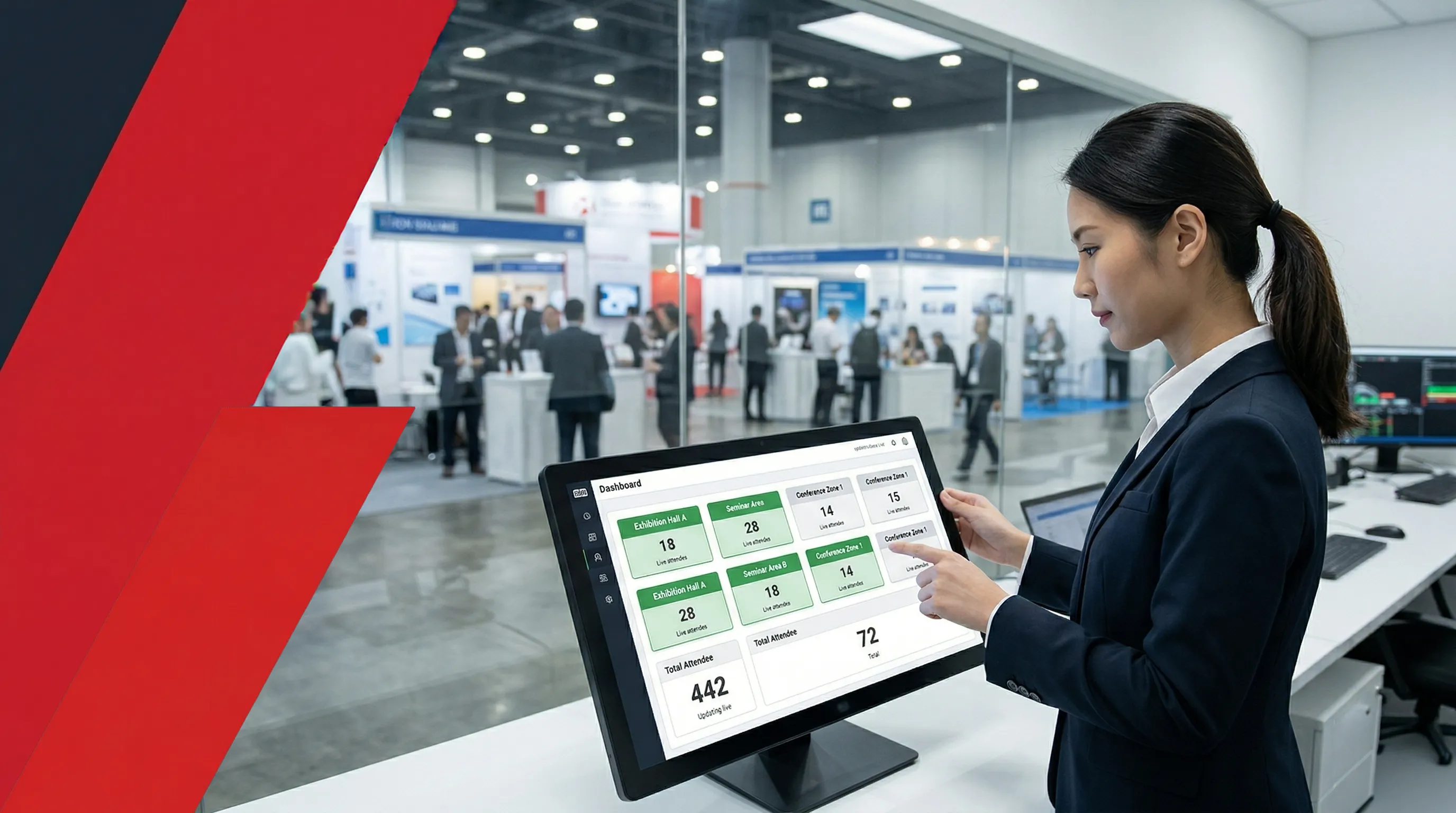
With UHF RFID zone gates integrated into the registration platform, standard deliverables include: unique visitor count (deduplicated), average dwell time per visit, total dwell time per visitor, hourly traffic distribution, repeat visit rate, and demographic breakdown by job title and industry from registration data. Premium sponsors increasingly expect real-time dashboard access during the event itself.